
Reading time: 10 minutes
Social Media Trends and Developments 2026 - Part 1: How AI is reshaping marketing
The Essentials at a Glance
How AI is changing marketing?
- AI is becoming standard in social media campaigns, but strategy, planning, control, and quality remain human.
- Automation, for example in content production, saves time but cannot replace clear brand logic.
- “AI slop” (AI content flood) makes human content more valuable than ever.
- New AI interfaces (companions, avatars) open up opportunities for service and commerce, but only with clear ethical guidelines.
- The global reach of social media content has been technically solved; relevance is the new bottleneck.
In 2026, the social media world will face a fundamental realignment: artificial intelligence and algorithms will automate almost every aspect of social media marketing, while users will simultaneously crave more authenticity. For brands, this means that more content and more technology will not automatically lead to greater impact. On the contrary, genuine attention will be harder to earn.
In 2026, artificial intelligence is no longer a trend or an isolated tool, but a layer that sits above all processes, especially in social media marketing.
- Campaigns are increasingly automated.
- Content is becoming a mass commodity.
- New AI interfaces such as chatbots are changing user behavior.
- Identities are becoming scalable through AI.
- Social media reach is becoming global.
In this article, we take a closer look at what is currently changing in the AI age. You can read about other trends and developments in the social media world beyond AI in part 2. This article deals with the strategic counter-movement: people as senders, the increased importance of communities, distribution issues, and the question of how brands will build trust on social media in 2026.
Table of Contents:
- AI creates and manages campaigns
- AI causes a flood of content
- AI companions as virtual BFFs
- AI influencers and scalable identities
- AI facilitates globalization
- Takeaways for brands
- Conclusion
AI creates and manages campaigns
Mark Zuckerberg's vision is getting closer and closer: in the future, companies will only have to register their credit card with Meta, and the platform will automatically optimize assets, target groups, and budgets for advertising campaigns. AI not only automates ads, but also lowers the production barriers for content.
For performance marketing, this means that the role of human input is changing: the focus is shifting from implementation to strategy, conception, and control.
However, not everything should be left to AI autopilot: while some campaigns perform better in AI-driven “Advantage+” mode, others suddenly lack an essential element of creativity, or summer music suddenly plays over the Christmas campaign.
For brands, this means that AI reliably optimizes based on platform logic. Brand logic must first be taught to AI, and then consistent control is required.
AI causes a flood of content
While it was challenging for companies to create moving image content not so long ago, AI is now generating an unprecedented flood of content on social media. However, much of it remains generic or is simply nonsense because, without a clear briefing, clear brand logic, and real context, AI primarily replicates patterns: beautiful images, smooth claims, and little substance.
With “Vibes,” Meta has launched a social media platform that consists exclusively of AI-generated content. But who cares?
The paradox of 2026: content is available in abundance, but attention is not. Simply producing more does not necessarily make you more visible, and relevance is still the order of the day.
To stand out from the crowd of so-called “AI slop,” it is becoming increasingly important for brands to focus on high-quality content by and with real people. Users long for genuine human connection. After all, “social” media is not called that for nothing.
AI companions as virtual BFFs
Digital companions such as chatbots or virtual avatars are designed to engage in social, emotional, or supportive interactions with people. This shows how platforms intend to extend usage time even more aggressively in the future. The business model is simple: the longer people stay in the respective social media app, the more advertising inventory is generated. TikTok & Co. are optimized for precisely this purpose.
In the age of AI, this has led to the emergence of chatbots on Meta and X, for example, which not only answer questions but also act as “best friends”: permanently available, always there for you.
The first examples of such digital companions range from questionable, hypersexualized avatars to helpers for everyday life and homework. Numerous cases already show how quickly users can confuse this virtual connection with reality.
For brands, this means that a new interface between users and platforms is emerging. This opens up opportunities for service, consulting, and commerce. At the same time, it creates sensitive risks (ethics, protection of minors, transparency, regulation).
AI influencers and scalable identities
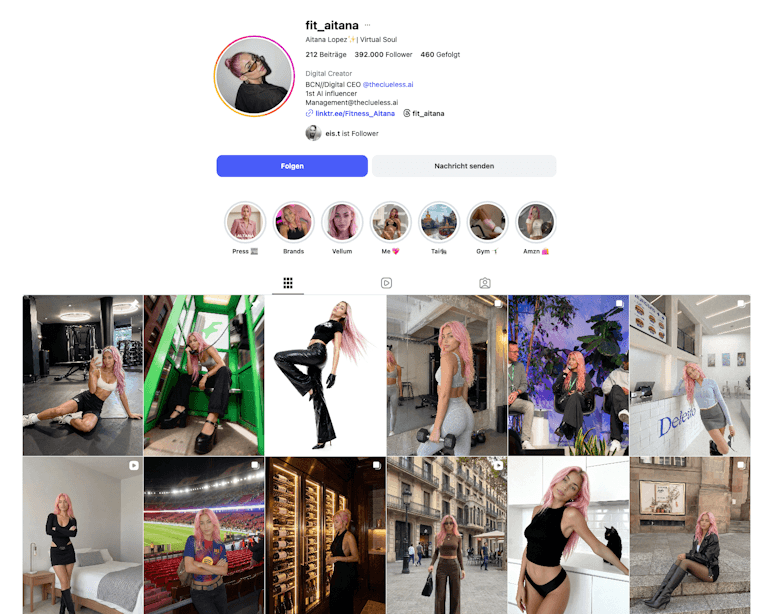
Influencer marketing has also entered the age of AI: fit_aitana has almost 400,000 followers on Instagram, to whom she presents outfits, fitness routines, and a luxurious life in Barcelona, sponsored by lucrative advertising contracts. Disappointing for the numerous admirers who slide into her DMs: the pretty lady with pink hair doesn't really exist, but is 100% AI-generated. The money is earned by The Clueless, the company behind her creation.
Historical figures are also being recycled: Katharina von Württemberg, founder of LBBW, has been dead for over 200 years. That doesn't stop the bank from having her answer questions for a campaign, with the help of AI, of course.
AI-generated influencing doesn't just work with fictional or resurrected personas, but also with doppelgangers: TikTok megastar Khaby Lame sold the rights to his face to a Nasdaq company in a shared equity deal worth just under a billion US dollars. As part of the deal, he makes his face, voice, facial expressions, and gestures available. AI can theoretically be used to create endless content assets for campaigns and the like, increasingly decoupled from the real person. The fundamental moral question behind this is: How much money would you be willing to give up your own identity for?
For brands, this is not just a creator issue, but a whole new category, including questions about rights, labeling, control, and reputation risk.
AI facilitates globalization
Thanks to AI-based live translation, language barriers are eliminated at the touch of a button, not only for texts but also for moving images: lip movements and voices are synchronized, and slang and language style are adapted.
This means that reach is no longer limited to a specific language area, and content is suddenly available to a global audience. This means that the quality and relevance of content is becoming increasingly important, regardless of the language in which it was originally produced. While this offers opportunities for small creators, it also reinforces the “winner takes it all” effect, as large accounts can become even larger.
For brands, this means that internationalization is becoming technically easier, but differentiation remains a challenge.
Takeaways for brands
- AI is becoming standard in social media campaigns, but strategy, planning, control, and quality remain human.
- Automation, for example in content production, saves time but cannot replace clear brand logic.
- “AI slop” (AI content flood) makes human content more valuable than ever.
- New AI interfaces (companions, avatars) open up opportunities for service and commerce, but only with clear ethical guidelines.
- The global reach of social media content has been technically solved; relevance is the new bottleneck.
Conclusion
AI will make social media marketing more efficient in 2026, but this development will not automatically lead to better communication. Platforms will become active players in the campaign process, content will become a mass commodity, new interfaces (such as companions or avatars) will change user relationships, and reach will no longer be tied to language.
For brands, this means that those who continue to focus primarily on output, visibility, and performance KPIs will become interchangeable. Relevance arises where automation meets clear senders. Brands must use AI without relinquishing their identity.
This article is about exactly that: people, communities, distribution, and why social media in 2026 needs to be moderated more than it needs to be played.