
Reading time: 15 minutes
WhatsApp Channels: Owned Attention Instead of Algorithm Dependency
The Essentials at a Glance
What are WhatsApp channels and who are they suitable for?
- WhatsApp channels are not a replacement for social media, but rather an additional distribution channel.
- The strength of the format lies less in discovery than in direct, plannable delivery.
- WhatsApp is particularly useful for brands with regular informational value, strong communities, launch logic, or clear personal brands.
- Exclusivity, timing, and a recognizable channel promise are more important than mere presence.
- Not every brand needs a WhatsApp channel, but every brand should consider its distribution strategy.
- For data-driven campaigns, the limitations of the format remain relevant: targeting, tracking, and control are still restricted.
Social media feeds are increasingly controlled by algorithms. This makes organic reach increasingly unpredictable for brands: visibility is no longer achieved solely through continuous presence, but also through platform logic such as watch time, shares, saves, comments, hooks, and other relevance signals.
While brands fight for visibility in feeds, users' fragmented attention is simultaneously shifting more and more to private spaces. Messengers, niche platforms, and closed communities are gaining in importance.
This is exactly where WhatsApp channels become interesting. First of all, they are not a new social network, nor are they a replacement for existing social media platforms. Rather, they are an additional distribution channel in an environment where reach is becoming less and less guaranteed.
We take a look at how WhatsApp channels can be used strategically for brands, which brands they make sense for (and which they don't!), and where the journey is headed in 2026 and beyond.
Table of Contents:
- What WhatsApp Channels are: A strategic classification
- 5 useful use cases for WhatsApp channels
- Which brands should utilize WhatsApp?
- What a good WhatsApp channel needs to offer
- Where are WhatsApp Channels heading?
- Conclusion
What WhatsApp Channels are: A strategic classification
WhatsApp Channels are a bridge between traditional broadcasting and messenger marketing: they are public channels within WhatsApp that users can subscribe to in order to receive regular updates from brands, media outlets, creators, or organizations. They can be found in the “Updates” section, where status messages are also displayed. Unlike in a normal chat or group, this is not about two-way communication, but rather one-way updates to many people at the same time.
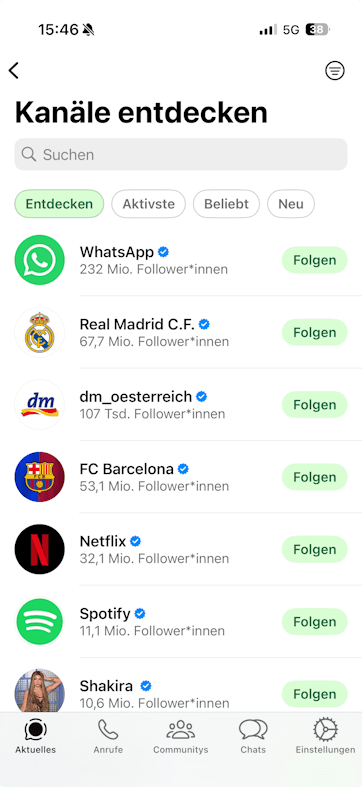
Content is displayed chronologically, is permanently available (does not disappear after 24 hours), reaches users directly in the app with low barriers to use, and can generate additional visibility via push notifications. At the same time, the format remains deliberately minimalistic: it is one-sided, not designed for 1:1 communication, and reactions are only possible to a limited extent. To understand WhatsApp Channels, it helps to compare them to traditional social media feeds: these are public, fast-paced, and highly competitive for attention, with content constantly vying for attention. A WhatsApp Channel works according to a different logic: users must consciously subscribe to it. Those who do so expect regular updates and actively choose to receive them. This means that the content does not have to compete with countless other posts, but above all has to fulfill a clear promise of expectation. This is precisely where the difference lies: social feeds are designed for discovery, while WhatsApp channels are designed for continuity. They are not primarily a place to reach new target groups, but rather to reliably address existing communities. Differentiating features: Social feeds vs. WhatsApp channels:
| Social Feed | WhatsApp Channel |
|---|---|
| algorithmic | chronological, direct |
| competition for attention | opt-in |
| comments and exchange | one-way broadcast |
| reach-oriented | engagement-oriented |
| public context | messenger context |
5 useful use cases for WhatsApp channels
Should brands be present on WhatsApp? The crucial question is what purpose they are pursuing. Channels can fulfill very different functions, depending on the type of content being communicated and the expectations that a target group has of the channel.
Use Case 1: Distribution & Reliability For media brands such as Tagesschau, WhatsApp is not an additional gimmick, but above all a reliable distribution tool. Anyone communicating about current developments, breaking news, or ongoing events benefits from the fact that content is delivered quickly, clearly, and directly on WhatsApp.
The strength of this tool lies not in elaborate staging, but in regularity, clarity, and timing. This format can therefore be particularly useful for brands with high informational value or ad hoc relevance: in addition to media, this can also apply to sports formats, politics-related communication, or industry news.
Takeaway: WhatsApp is particularly suitable for brands whose added value lies in continuous, fast, and direct information.
Use Case 2: Intimacy Layer for Personal Brands WhatsApp can be a useful addition to traditional social media platforms, especially when a person is at the heart of the brand, as it helps to create a more personal connection. In such cases, however, reach is still primarily achieved via public channels such as Instagram or TikTok. The WhatsApp channel takes on a different role: it becomes an additional level for greater proximity.
Pop stars like Olivia Rodrigo use WhatsApp channels, for example, to inform fans directly about new releases, concert dates, or personal updates.
This format can be particularly interesting for personal brands, founder personas, or corporate influencers, as it emphasizes closeness and regularity more than public performance. This is especially exciting for senders who are followed not only for individual content, but also for who they are as a person.
Takeaway: WhatsApp is particularly suitable for personal brands where not only the content but also the direct connection to the person is part of the added value.
Use Case 3: Eventization & Cultural Moments Series launches, trailer drops, and live events usually only generate increased attention for a short period of time. A WhatsApp channel can help brands that communicate heavily during peaks not only make them visible in social media feeds, but also extend them in a targeted manner.
One example of this is Netflix: The streaming service uses its WhatsApp channel around major releases to inform fans directly about new series launches or upcoming episodes.
Takeaway: WhatsApp is particularly suitable for brands that regularly generate releases, events, or cultural peaks and want to play them out to their community in a targeted manner and extend them.
Use Case 4: Emotional fan loyalty Fans of a brand usually want to see not only the big results, but also everything that happens in between. This is precisely where the appeal of WhatsApp lies for brands with a strong community: the channel is well suited for everything that conveys closeness, topicality, and presence. Those who are already being followed on an ongoing basis can play out relevant updates more directly instead of hoping for visibility in the feed every time. The channel then becomes less of a news ticker and more of an ongoing connection between the brand and the community.
This logic is illustrated quite well by VfB Stuttgart, for example: the club uses WhatsApp to provide fans with information about the club directly, such as news, real-time updates, exclusive competitions, and backstage material. In sports in particular, the desire for proximity to the action is especially strong, but the principle can also be applied to other areas. Cultural institutions such as theaters could also use such a channel to bring the audience closer to the action with insights, last-minute updates, or behind-the-scenes moments.
Takeaway: WhatsApp is particularly suitable for brands whose target groups are not only interested in specific topics, but also want to stay informed and close to the action on an ongoing basis.
Use Case 5: Conversions & Drops When it comes to product drops, limited releases, or restocks, it's often not about elaborate storytelling, but above all about timing. People want to know in a timely manner. This is exactly where a WhatsApp channel can be useful. Information about early access, new collections, discount codes, or products that are available again reaches those who have consciously signed up for it directly. This can be particularly advantageous for D2C brands, as the channel not only generates attention but, in the best case scenario, also brings them closer to conversion.
Brands such as Snocks use WhatsApp precisely according to this logic: not as an additional feed for general brand messages, but as a direct channel for product-related communication. The appeal lies primarily in exclusivity and immediacy. Those who subscribe to the channel ideally want to feel that they are being informed earlier or more directly than others.
Takeaway: WhatsApp is particularly suitable for brands that regularly communicate product launches, limited drops, or restocks and can offer their community concrete added value in the process.
Which brands should utilize WhatsApp?
With all these possibilities, it is worth taking an objective view: not every brand automatically needs a WhatsApp channel. Brands that test formats early on can certainly gain a first-mover advantage: less because of immediate reach gains than because of the opportunity to learn early on what content works in this context. As with many new platforms or platform features, however, presence alone does not create strategic added value. In summary, a WhatsApp channel can be particularly useful for brands that already have an active community or regularly create opportunities for updates. These include, for example, media brands, sports organizations, entertainment formats, or D2C brands with a clear launch logic. Personal brands, founder personas, or corporate influencers can also benefit from a channel, as proximity and continuity play a greater role here than reach. It is more difficult for brands whose communication is strongly focused on campaigns or isolated marketing moments. Those who rarely have relevant updates or cannot deliver clear added value will find it difficult to keep a channel interesting in the long term. Another point is measurability: WhatsApp Channels currently offer only limited options for targeting, conversion tracking, or detailed performance analyses. For brands that rely heavily on data-driven campaign management, this can be a significant limitation. At the same time, the channel is less complex to operate than many traditional social media platforms. The effort involved arises primarily when brands try to use it as an additional content channel instead of using it specifically for updates or distribution.
What a good WhatsApp channel needs to offer
For a WhatsApp channel to reach its full potential, it needs more than just presence. It is crucial that the channel has a clear place in the brand's communication system and offers recognizable added value for the target group.
- A clear promise: People will only subscribe to a channel long-term if it's clear what they'll get there: exclusive updates, early access, relevant information, or a more direct look behind the scenes.
- The right balance: Too many updates quickly become annoying, too few make the channel irrelevant. Especially in the context of messaging, which can quickly feel intimate, you need a good sense of frequency and timing.
- The right tone: WhatsApp works differently than a traditional corporate channel. If you sound too promotional or too formal here, you're wasting potential. Instead, it usually works better to sound like a real update rather than a press release.
- Meaningful integration: The channel is strongest when it complements existing channels. As a reminder, an additional touchpoint, or a direct line for relevant updates.
Where are WhatsApp Channels heading?
When it comes to WhatsApp Channels, the most exciting question is what role they will play in brands' channel mix in the future. There is much to suggest that they will not establish themselves as a mass channel for all types of content, but rather as a specialized space for updates, launches, community information, or exclusive tips.
Overall, there are many indications that brands will invest more heavily in owned distribution, such as broadcast channels (WhatsApp Channels, Instagram Broadcast Channels, etc.). While feeds provide reach, messengers could become more important when it comes to relationships, repeat visits, and direct communication. It will also become more relevant for brands to know which creators reach their community not only in feeds, but also in more direct spaces such as WhatsApp. With influData, creators who use WhatsApp as an additional channel can be specifically identified.
WhatsApp channels are not a substitute for social media, nor are they a sure-fire success. This is precisely what makes them strategically interesting. They work best where brands don't just want to use “another channel,” but have a clear reason to be present directly in the messenger: with relevant updates, proximity, exclusivity, or good timing. For many brands, channels will therefore not be a mass channel, but a specialized component in the channel mix.
Conclusion
- WhatsApp channels are not a replacement for social media, but rather an additional distribution channel.
- The strength of the format lies less in discovery than in direct, plannable delivery.
- WhatsApp is particularly useful for brands with regular informational value, strong communities, launch logic, or clear personal brands.
- Exclusivity, timing, and a recognizable channel promise are more important than mere presence.
- Not every brand needs a WhatsApp channel, but every brand should consider its distribution strategy.
- For data-driven campaigns, the limitations of the format remain relevant: targeting, tracking, and control are still restricted.