
Reading time: 15 minutes
Fitness Brand Analysis - What we can learn about Social Media Marketing from the top fitness brands
The Essentials at a Glance
How can I increase my engagement rate and reach on social media? With serial formats for posts, content can not only be scaled, but also incorporated in a way that is algorithm-friendly. In addition, a good hook to get started and recognizability through setting, tone, recurring characters, text style, and sound are important. Comment opportunities that are not forced encourage engagement and provide relevant incentives in competitions for the right audience on your channel. With Instagram Broadcast Channels, you can create exclusivity, and if you ever have a viral post, make sure you have follow-ups ready to go.
New year, new me: “This year, I'm really going to go to the gym more often!” Who hasn't heard this before? Many people start the new year with this resolution. This makes January peak season for gyms: there are numerous new registrations and trial workouts, and people are particularly receptive to offers.
Which gym we choose depends on several factors: location, value for money, equipment and course offerings, but also brand preference. Often, it is a friendly, well-structured, and wide-reaching social media presence that attracts attention and shapes brand preference.
To uphold these values, gyms also need discipline and good intentions for their feeds. What might these look like in 2026, and what can we as brands outside the fitness industry learn from them?
We investigated which fitness brands in the DACH region achieved above-average reach and engagement rates (simplified: ratio of interactions such as likes, comments, and shares to the follower base) on Instagram in December.
Table of contents:
- The Top 20 Fitness Brands
- Case 1: FitPlus – Content balancing act between Advent calendars and B2B
- Case 2: FitX – Advent calendar as a content engine
- Case 3: Fitness First Germany – Shiny content as a challenge
- Case 4: basefive_ – Peak reach as borrowed attention
- Conclusion
- Ins & Outs for Social Media Marketing 2026
The Top 20 Fitness Brands
We have listed the top 20 brands by engagement rate and reach (based on content pieces published on Instagram in December, i.e., posts and reels) in the tables below.
What patterns are behind the strongest performances, and which of these will make it onto our ins vs. outs list for social media marketing in 2026?
| Brand | Country | Ø Engagement |
|---|---|---|
| fitplus.franchise | DE | 20.46% |
| fitx | DE | 10.65% |
| intersport.de | DE | 9.67% |
| fitnessfirstger | DE | 8.74% |
| fitseveneleven_ | DE | 8.25% |
| fitnessfirst.austria | AT | 8.00% |
| holmesplaceaustria | AT | 6.64% |
| primetimefitness | DE | 3.26% |
| basefive_ | AT | 3.05% |
| intelligentstrength | AT | 2.71% |
| happyfit.eu | AT | 2.51% |
| terra.sports.official | DE | 2.42% |
| mammut | CH | 2.31% |
| globetrotterde | DE | 2.29% |
| injoyvechta | DE | 2.27% |
| beat81.hamburg | DE | 2.23% |
| pfitzenmeier | DE | 2.17% |
| fitnessland.de | DE | 2.14% |
| hammer.de_ | DE | 1.99% |
| fitstar_de | DE | 1.78% |
| Brand | Country | Reach |
|---|---|---|
| mammut | CH | 5,446,432 |
| puma | DE | 4,239,079 |
| fitx | DE | 3,534,087 |
| fitnessfirstger | DE | 3,195,167 |
| intelligentstrength | AT | 1,382,046 |
| rose_bikes | DE | 1,284,193 |
| theurbanheroes | DE | 1,256,341 |
| ai_fitness_de | DE | 967,174 |
| cube.bikes | DE | 951,169 |
| mcfit | DE | 820,141 |
| primetimefitness | DE | 736,917 |
| basefive_ | AT | 736,560 |
| bergfreunde | DE | 639,622 |
| intersport.de | DE | 560,649 |
| dynafit | DE | 539,737 |
| cleverfit | DE | 515,099 |
| globetrotterde | DE | 441,229 |
| intersport.at | AT | 355,484 |
| fitseveneleven_ | DE | 308,201 |
| holmesplaceaustria | AT | 259,344 |
Case 1: FitPlus – Content balancing act between Advent calendars and B2B
With an engagement rate of around 20%, the franchise account of FitPlus is right at the top in December. The profile is a good example of why high engagement rates can be misleading without context: for small accounts (fitplus.franchise has only around 1,400 followers), the engagement rate can rise sharply even with relatively few interactions. This is exactly the case here.
But what is particularly interesting is how these interactions come about and what brands can learn from them. FitPlus primarily activates engagement in December using a classic Advent calendar mechanism: static door posts with clear participation logic (follow, like, tag a friend). This is neatly implemented and reliably generates likes and comments. At the same time, a look at the creatives shows where the format has potential: the prize is not visible in the post itself, the visuals are very similar and more like “calendar pages” than scroll stoppers. On Instagram, where watch time and speed strongly influence the algorithm, this quickly wastes potential reach. Instead, a consistent framework would be better, but with a clearly varying scroll stopper for each door: prize or benefit immediately visible, stronger hook in the first frame or as a reel with speed instead of a static calendar page.
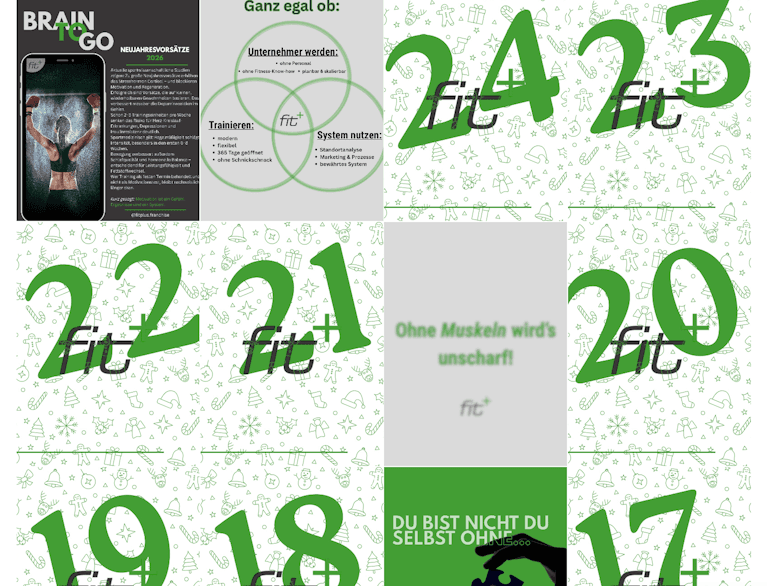
There is also a strategic point that is particularly striking with FitPlus: as a franchise account, FitPlus is clearly positioned towards B2B partners, but the content mix seems to be a balancing act between B2B (franchise/system topics) and B2C (training tips, Advent calendar). The problem here is the target group logic: those who enter via fitness content suddenly find themselves in franchise communication (and vice versa). While this may generate reactions, it does not automatically build relevance.
The lesson: Engagement can be mobilized quickly. However, it only becomes sustainable when the target group and format are a good fit, i.e., either franchise content is consistently designed as a platform-appropriate series (such as partner stories, Q&As, location builds as reels) or B2C content is clearly implemented as a separate, Instagram-native stream (less text graphics, more reels/storytelling/UGC).
This is precisely why it is worth looking beyond the pure ratings: it is not only decisive who has the highest engagement rate, but also who builds interaction in such a way that it functions stably even with a larger reach (regardless of whether paid or organic) and can thus be translated into scalable brand relevance.
Takeaways for brands
- Read KPIs in context: High engagement rates can be achieved quickly with small accounts, but this does not necessarily translate into scalable brand impact.
- Implement contest content in a platform-appropriate manner: Static door posts get likes and comments, but sacrifice watch time and reach. Reels plus a clear hook scale better.
- Clearly separate target groups: B2B franchises and B2C fitness in the same feed dilute relevance. It is better to have consistent series logic for each target group.
Case 2: FitX – Advent calendar as a content engine
In December, German discount fitness chain FitX not only achieved enormous reach on Instagram (over 3.5 million impressions for all posts and reels combined!), but also consistently high interaction rates (over 10,5% on average) with the community. These figures thus provide an ideal springboard for potential new registrations in January.
Like many other brands, fitX integrated an Advent calendar into its posting schedule in December. Fair enough: this is a common approach to quickly and comparatively cheaply generate a lot of reach and strong engagement, although such competitions should not be a long-term strategy, as they encourage engagement based on the desire to win rather than interest in the content. This can devalue the rest of the content and, in the long term, lead to a decline in reach. What stands out at FitX, however, is the successful presentation: Instead of static feed posts with random incentives, each Advent calendar door is a channel-appropriate reel (a top-reach format that the Instagram algorithm prefers to play) with a quick introduction and fast editing, comedy elements, a casual gym setting, and high-quality prizes that fit thematically into the world of fitness and lifestyle.
Sports watches, performance diagnostics, fitness food bundles: instead of simply giving away “something expensive,” the incentives clearly connect to the brand and are embedded in the captions in a humorous and pointed way. The calls to action are clearly and repetitively worded and often include buddy tags, which further supports organic content distribution.
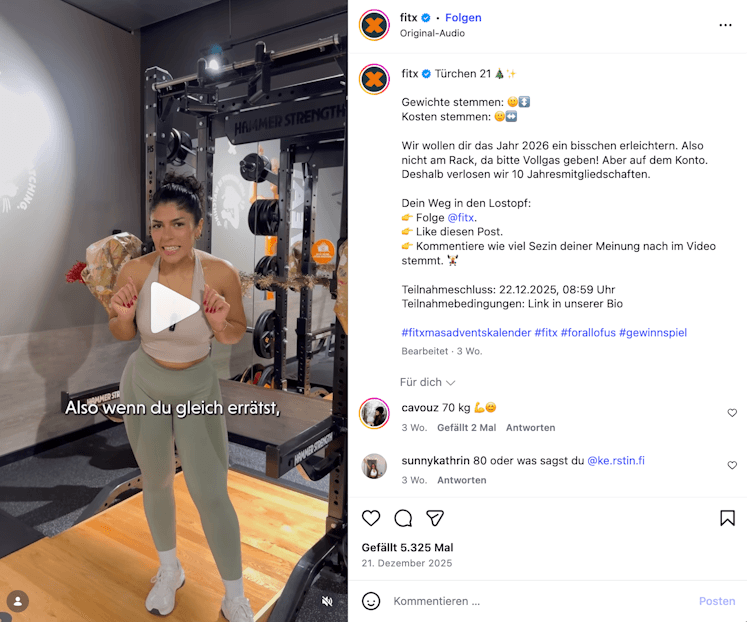
The contest content is therefore not out of place in FitX's editorial plan – other posts are also based on comedy and interaction-driven formats (“Stop the reel for your New Year's fitness prediction,” “Gym Bro Essentials,” and similar). The contest posts are so brand-fit in terms of tone, setting, and content that they not only generate reach but are also highly likely to appeal to the right target group, for whom the account's content remains relevant even beyond the contest.
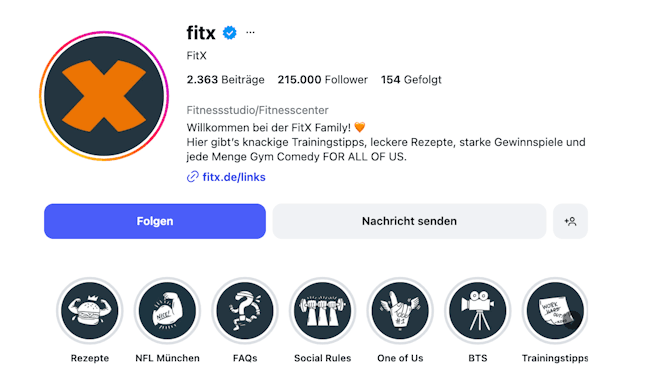
This is achieved in part through an often underestimated conversion lever: the profile description. FitX positions itself clearly here and shows what the account delivers: training tips, recipes, contests, and gym comedy. Anyone who lands on the profile via a played post quickly recognizes what the account stands for – and whether it's worth following beyond the contest.
Takeaways for brands:
- Series logic: Replicable series formats ensure recognition value and growth.
- Relevance beats price: A thematically appropriate prize is often more valuable than an expensive and arbitrary one.
- Expectation management: Profile visitors should quickly recognize the added value of the account.
Case 3: Fitness First Germany – Shiny content as a challenge
The German chain Fitness First Germany also used the typical Advent calendar mechanism in December, making it one of the fitness studios with the strongest Instagram engagement in the DACH region during this period.
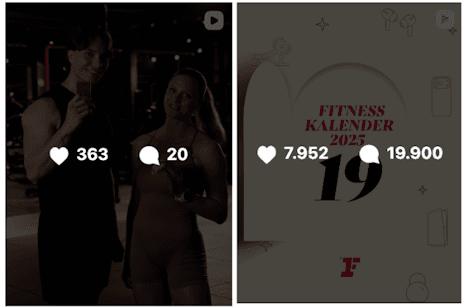
A closer look at the posts reveals that the work here is conscientious, professional, and high-quality. This Advent calendar also features high-value prizes packaged in reels that are cleanly filmed, brand-compliant, and very “premium” in their look and feel.
However, this is precisely where a challenge lies that affects many larger brands: clean content that generates little friction (among users and in the internal marketing approval loop) does not necessarily scale best on social media platforms.
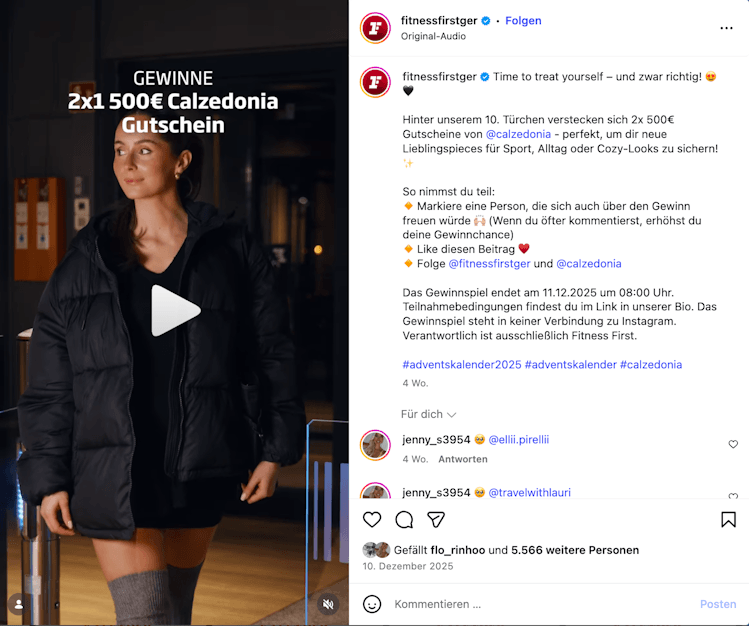
The following phenomena are often observed: The introduction follows a conventional setup (in this case, an intro animation that is a little too long) instead of starting with a clear hook. The entire dramaturgy (“Winnings are presented”) screams advertising rather than genuine, entertaining social content. The incentives are high-priced, but the added value of the account is not immediately apparent.
Of course, this does not mean that Fitness First Germany's approach is “wrong” in this case – after all, enormous reach and interaction figures were achieved. From a brand perspective, however, the following strategic questions should be asked: Do these interactions build genuine brand relevance? And: What happens after the promotional phase? If the interaction-driving formats are followed by a return to generic, static info posts (in this case, a rather dry carousel about “reasons why your biceps aren't growing”), the potential of the newly gained attention will probably be quickly wasted.
Takeaways for brands
- Adapt TikTok logic: What works on TikTok often performs well on Instagram too – less advertising look, more authenticity. Raw, platform-oriented formats with hooks, storytelling, humor, POVs, and trends beat glossy ones.
- Incentives need to be tailored to the target group: The added value of a prize should be tailored to the needs of the target group.
- Follow up on campaigns: If you attract new followers with competitions, you should have the next steps ready quickly.
Case 4: basefive_ – Peak reach as borrowed attention
basefive_ is an Austrian gym with three locations in Tyrol and, compared to large gym chains, a smaller account. Basefive's content in December also consisted mainly of Advent calendar posts, with one highly interactive outlier post standing out from the rest.
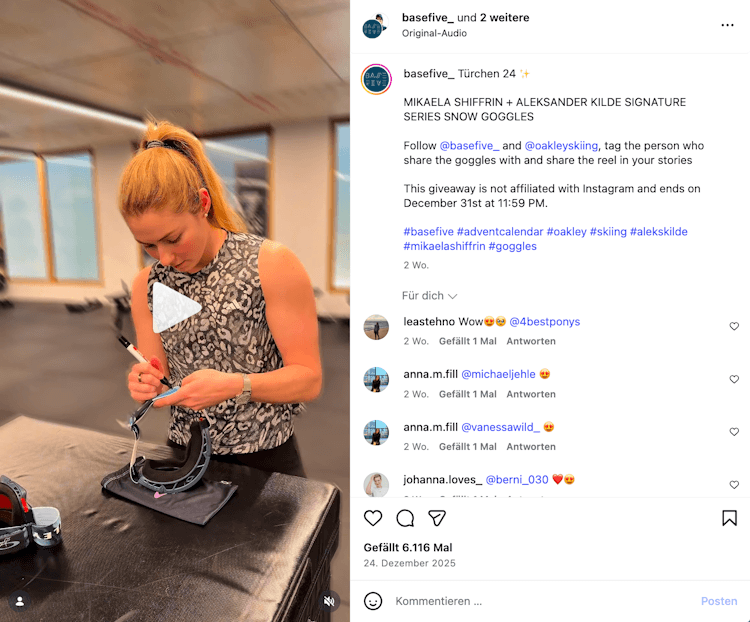
The post from December 24, which received many times more views and interactions than the other doors, shows ski stars Mikaela Shiffrin and Aleksander Kilde doing sports and then signing a pair of ski goggles that are being raffled off as part of the post. Because it is set up as a collaboration post with a large Shiffrin fan page, Basefive also reaches their followers. This post is visually appealing, prominently cast, and understandable in seconds. However, it is also a good example of why rapid reach and short-term engagement alone do not necessarily translate into lasting brand impact.
The challenge here lies primarily in connectivity. If the rest of the content on the account consists of local event announcements and regional activations, newly acquired profile visitors will quickly experience a disconnect. They come for an extraordinary moment and end up in a feed that has no real added value for them.
This is precisely where success in the form of short-term attention differs from impact in terms of long-term brand preference. Prominence often generates borrowed attention, which only becomes sustainable if the brand can quickly show what it stands for and what recurring content promise lies behind it.
The solution is not to avoid collab posts altogether. On the contrary: they are a powerful tool when they contribute to a planned story. It would make sense, for example, to translate the peak into a recurring format (e.g., “Guest/Athlete of the Month,” “Event Diary,” additional snippets with celebrities from the original production) and immediately follow up with 2–3 posts that are understandable nationwide and work even without local context. This keeps the feed relevant for new visitors, even if they are not from the region.
The strategic consequence: if you achieve reach with a “peak post,” you need a plan for the next steps. Otherwise, the effect will fizzle out and, in the best case scenario, the account will be left with a nice spike but without a permanently stronger community.
Takeaways for brands
- Borrowed attention: Short-term celebrity reach must be transferred to your own brand world.
- Peak ≠ strategy: After strong posts, sequel formats, series spin-offs, and a clear content promise are crucial.
- Make added value visible: Anyone new to the profile must immediately understand: “What do I get here?”
Conclusion
The four examples represent very different approaches, all of which increase engagement in their own way: serial engine; high-quality but slightly too promotional campaign content; peak reach with follow-up demand.
In order to successfully engage in social media marketing in 2026 and benefit from engagement in the long term, one question remains central: Do we have a system that translates attention into brand relevance?
Ins & Outs for Social Media Marketing 2026
✅ INs
- Series formats: Recurring content series are scalable and algorithm-friendly because they deliver consistent signals: similar structure, similar target audience, similar watch time/engagement patterns.
- Hook discipline: The first few seconds are crucial: no logo intro, no slow setup. Branding is welcome in the image (corner logo/studio look), but the introduction must immediately deliver value and excitement.
- Brand codes in every scene: Recognizability through setting, tonality, recurring characters, text style, and sound, so that content immediately looks like “you.”
- Comment opportunities that are not forced: Users rarely comment “just because”: they need a specific reason and an easy response option. Instead of “write in the comments,” guidelines work better: decisions (“A vs. B”), short questions, hot takes, or mini-challenges. UGC can also be activated via 1 hashtag and a few rules, ideally with recognition via reposts/highlights/reactions.
- Relevant incentives for competitions: Prizes/promotions that increase target group fit instead of attracting “freebie hunters.”
- Peak planning: Peaks often result from content created in collaboration with celebrities or in connection with events/partnerships. Important: Have a follow-up ready (sequel, series spin-off, profile funnel: description in bio, story highlights, and feed design as a reason to follow), otherwise the effect will fizzle out. With the influencer marketing tool influData, peaks and top formats can be quickly identified and used accordingly.
- Use Instagram broadcast channels: Exclusive updates for followers directly in their DMs, without public visibility, but also without algorithm dependency. These increase engagement, loyalty, reach (through reposting), and bring feedback and higher brand loyalty.
❌ OUTs
- Static contests and informational posts: If you're going to do them, make sure they're platform-appropriate (reels, fast-paced, clear storytelling).
- High-gloss “TV commercial” reels: Too smooth, too slow, too promotional, and often without watch time logic for the target audience. Think TikTok first, even for Instagram content.
- Approval optimization as a content strategy: Low risk does not mean effective: Instagram is not a corporate newsletter – authentic, less promotional content often goes down better.
- Celebrating numbers without impact: Followers, likes, views: bravo! But: The most important thing is still whether this translates into relevance in the form of brand preference and potential purchases.